

European Transport Corridors
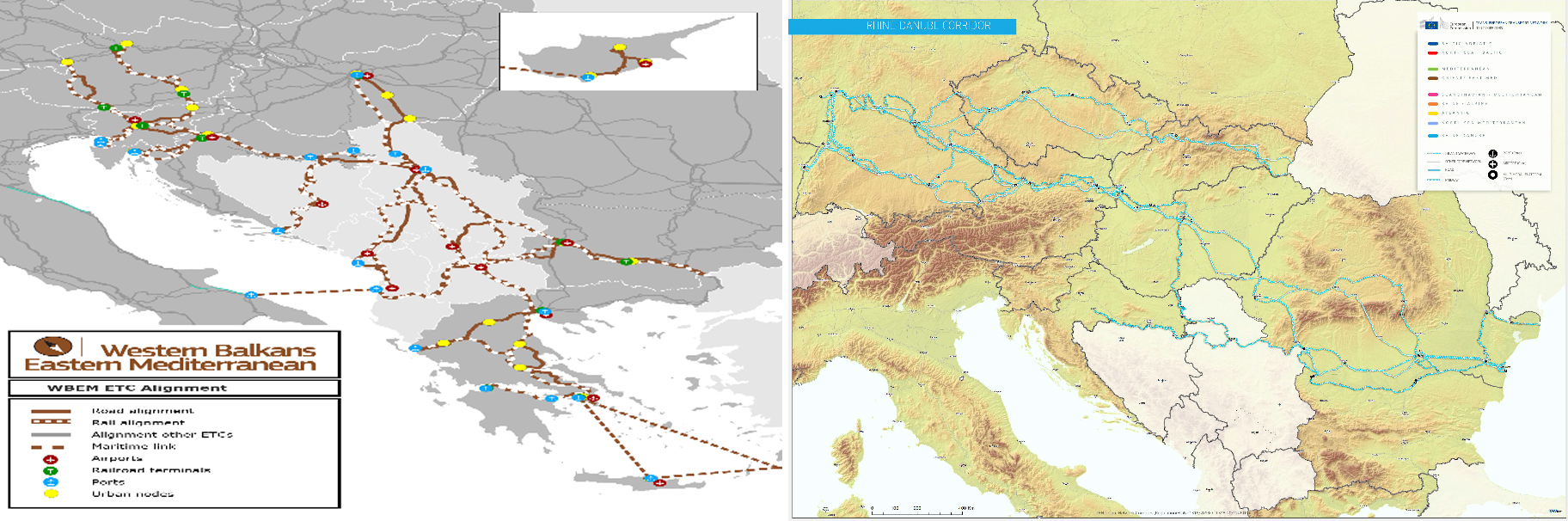
Transport Corridors: Western Balkans – Eastern Mediterranean and Rhine - Danube
In accordance with the defined scope of activities of the Sector within “Putevi Srbije” LLC, the Sector for Strategy, Designing and Development performs activities related to technical preparation, strategic planning, studies and research, development, design, planning documentation, road safety, environmental protection, preparation and maintenance of records, as well as administrative and technical activities related to the Sector’s scope of work. It also participates in and provides support for the implementation of projects financed by international financial institutions, European funds and under intergovernmental agreements.
The Sector for Strategy, Designing and Development comprises the following departments:
- Department for Technical Preparation
- Department for Strategic Planning, Studies and Development
- Department for Design Documentation
- Department for Traffic Safety
- Department for Environmental Protection
- Department for Energy Management
- Department for Planning Documentation
The Sector for Strategy, Designing and Development is responsible for implementing the design process, taking into account road safety, environmental protection and energy management considerations, and represents one of the key elements in optimising construction, operation and maintenance of non-urban roads, as well as the overall socio-economic development. The timely preparation of planning and technical documentation, accompanied by the relevant studies, is a prerequisite for making the most important decisions on where and when to build.
The Sector has successfully implemented general and preliminary designs, designs for construction permits, reconstruction, rehabilitation and upgrading of Category I and Category II state roads and road structures, the required preliminary and feasibility studies, road improvement and management projects, traffic studies, traffic regulation designs, the required planning documentation, environmental impact assessment studies, research and development projects, as well as projects implemented under the cross-border cooperation programmes IPA Interreg – IPA CBC Hungary–Serbia and IPA Interreg – IPA CBC Romania–Serbia. We would particularly highlight the recently completed DANUBRIDGE CONNECT project – Implementation of New and Advanced Technologies for the Preparation of Infrastructure for Better Transport Cooperation and Connectivity in the Danube Region – as well as other projects financed by the European Union and implemented through the MCTI, in which “Putevi Srbije” LLC participates as a full partner.
The Sector actively participates in the implementation of intergovernmental agreements with China, Azerbaijan and Turkey, including the coordination and preparation of planning and technical documentation for the construction of motorways and expressways.
The Sector for Strategy, Designing and Development is currently providing support for the implementation of the Local Infrastructure and Institutional Development Project, implemented by the Government of the Republic of Serbia with the support of the World Bank and the French Development Agency. With a total planned value of EUR 265.2 million, the project is intended for local self-governments in the Republic of Serbia for the implementation of investment projects in road infrastructure, non-motorised transport and general mobility, reduction of adverse impacts of climate change on infrastructure and enhancement of infrastructure resilience, greening of public areas, public lighting, aimed at improving pedestrian and traffic safety, as well as strengthening the professional capacities of local self-government units through continuous technical support in relevant areas.
The Sector is also involved in the implementation of the new Sustainable Road Network Improvement Project, financed with the participation of the European Investment Bank, the French Development Agency and other financing sources. The project represents an investment programme with an indicative value of up to EUR 300 million in the Republic of Serbia. It is designed to support the “Putevi Srbije” LLC investment programme and will be implemented over a five-year period. The project covers local and state roads with an estimated total length of 540 km. Investments will focus on improving the existing road network (state and local roads) through rehabilitation, reconstruction and modernisation of infrastructure. Particular emphasis is placed on increasing the resilience of the road sections covered by the project to climate change and on road safety aspects.
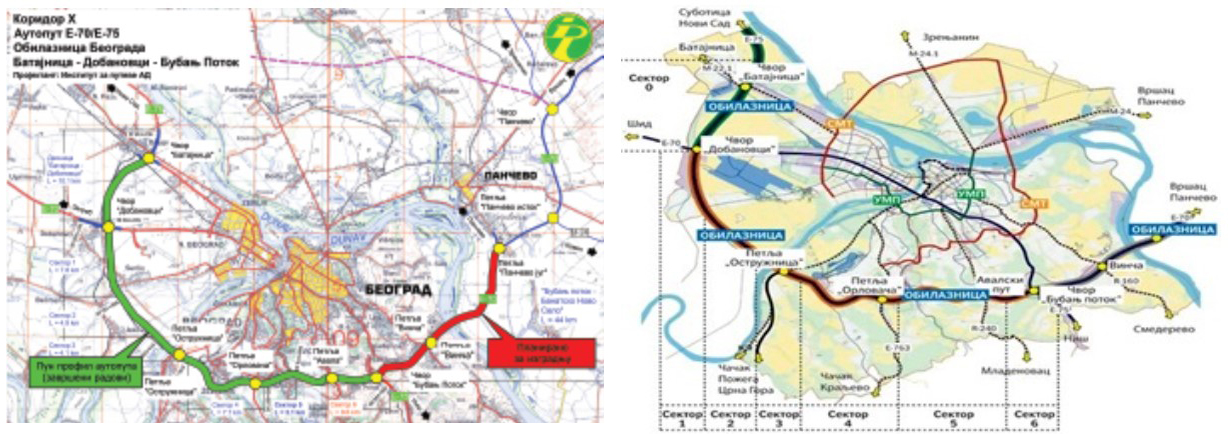
Our work is currently focused on the preparation of planning and technical documentation for the completion of the future TEN-T network, including completion of the entire Belgrade Bypass as far as Pančevo, including a new combined rail-road bridge across the Danube near Vinča, thereby forming an integrated transport system together with the Inner and Outer Main Ring Roads, which form part of the City of Belgrade road transport system.
Documentation is being finalised for the demolition and construction of the approach structures on the right bank of the Danube for the Pančevo rail-road bridge on the IB Category State Road No. 47, Bogoslovija–Krnjača Interchange section (these activities are being coordinated with the construction of the first metro line in the immediate vicinity). Following completion of the new rail-road bridge across the Danube near Vinča as part of the new section of the Belgrade Bypass (Bubanj Potok–Pančevo section) and the diversion of traffic to the new section, the conditions will be created for highly complex works on the entire Pančevo Bridge across the Danube.
In addition to the above sections, there are also sections that are not part of the TEN-T network but are extremely important for the efficient functioning of traffic in Belgrade: the newly constructed Surčin–Novi Beograd section and the new Belgrade–Obrenovac expressway section, which is currently under design. The design of the reconstruction of the IB Category State Road No. 22, Čukarica–Barajevo–Obrenovac–Lazarevac, together with the bridge and approach roads in Obrenovac, is also planned.
Implementation of these projects will complete a set of road infrastructure projects that will significantly improve traffic flows in Belgrade, reduce congestion and traffic delays, and at the same time provide a permanent solution to the most significant bottleneck on the future TEN-T road network through Serbia.
In the process of Serbia’s European integration and its path towards full EU membership, Serbia, through cooperation with the Transport Community, aligns its priorities and technical standards with EU priorities and standards.
The Republic of Serbia currently has the status of a candidate country for full EU membership, which it obtained in 2012, аnd the transport policy of the Republic of Serbia is aimed at achieving economic and social development objectives and alignment with the EU transport policy. Following the path of European integration, significant efforts have been made in recent years to harmonise the national transport legislation with the European Union legislation.
The indicative extension of the TEN-T core network, extended core network and comprehensive network to the Western Balkans is provided for under EU Regulation 2024/1679 and included in Annex I.1 to the Treaty establishing the Transport Community.
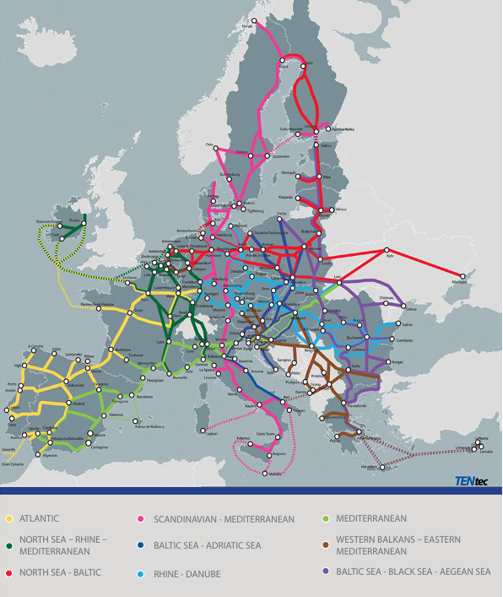
The European Union continuously monitors the implementation of project activities through the Transport Community and through the bodies monitoring the implementation of individual trans-European transport corridors, two of which pass through Serbia: the Western Balkans–Eastern Mediterranean Corridor and the Rhine–Danube Corridor.
The Fifth Annual Report on the Trans-European Transport Network (TEN-T) was based on the TODIS logistics, with data collected and verified through the network of designated regional users and with contributions from the technical committees.
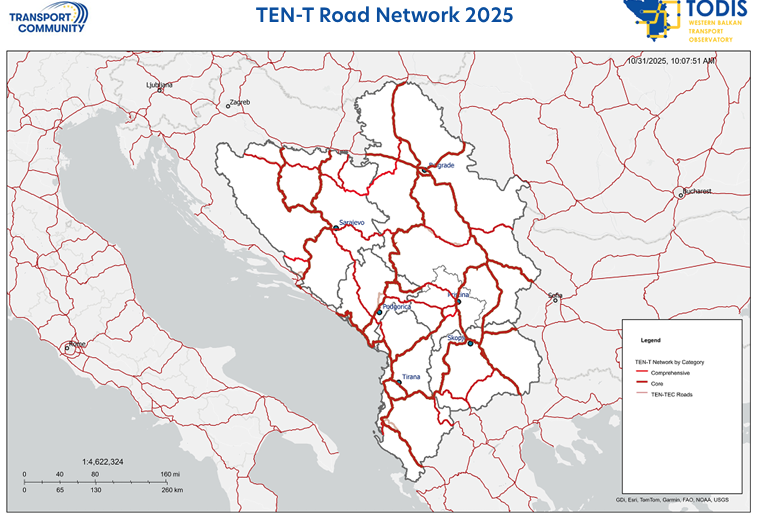
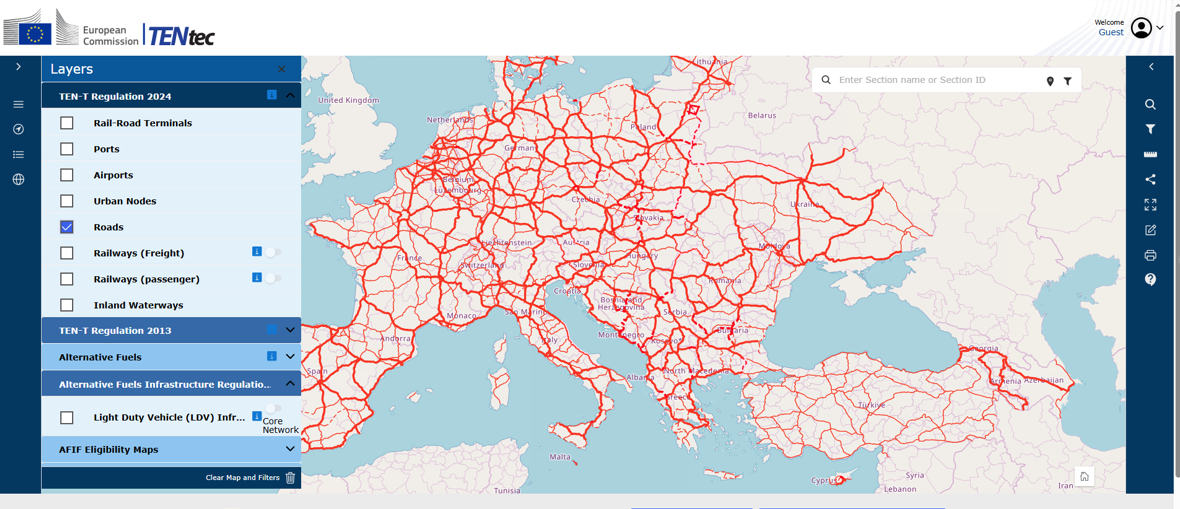
Basic and Comprehensive TEN-T Road Network
https://webgate.ec.europa.eu/tentec-maps/web/public/screen/home
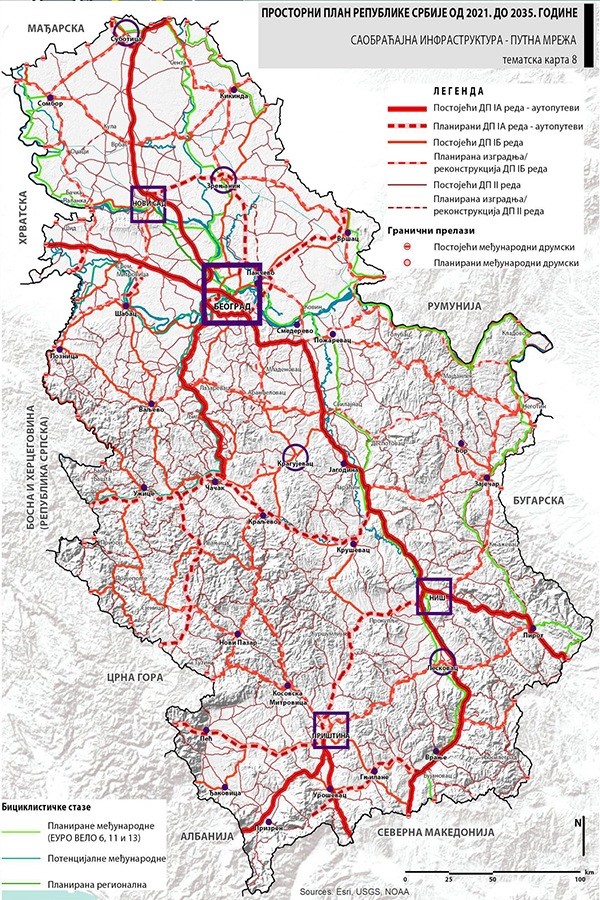
The basic road network of the indicative TEN-T network comprises the following routes:
1) Corridor X, including branches Xb and Xc
The Corridor X motorway along the Batrovci–Belgrade–Niš–Preševo route has been completed to full motorway standard, while planning and design documentation is currently being prepared for the new Vranjska Banja Interchange.
On Branch Xb, along the Horgoš–Belgrade route, the motorway has been completed to full motorway standard. Planning and design documentation is currently being prepared for the new Maradik interchange and for increasing the capacity of this section.
On Branch Xc, along the Niš–Dimitrovgrad route, the motorway has been completed to full motorway standard.
2) Route 4 – Belgrade–Pančevo–Vršac and Belgrade–Boljare
Route 4 comprises the Belgrade–Pančevo–Vršac route, extending to the border with Romania, and the Belgrade–Boljare route, extending to the border with Montenegro.
Construction of a motorway is planned along the Belgrade–Pančevo–Vršac route. Planning and design documentation is currently being prepared for the first section – Sector C of the Belgrade Bypass, from Bubanj Potok to Pančevo. Planning and design documentation is also being prepared for the subsequent section Pančevo-Vršac-border with Romania.
Along the Belgrade–Požega route, the motorway has been completed, while planning and design documentation is currently being prepared for the continuation from Požega to Boljare, to the border with Montenegro.
3) Route 7 – Niš–Priština
Along the Niš–Priština route, the first section, Niš–Pločnik, is under construction to semi-motorway standard, while planning and design documentation is being prepared for the Pločnik–Merdare section.
The comprehensive road network within the indicative TEN-T network comprises the following road routes:
1) Route 3 – Požega – Kotroman (border with Bosnia and Herzegovina)
Construction of this road route is planned, and planning and design documentation is currently being prepared.
2) Route 5 – Pojate–Preljina–Požega and Paraćin–Zaječar
The Pojate–Preljina motorway is almost entirely completed, while the Preljina–Požega section has been opened to traffic.
For the section of Route 5 along the Paraćin–Zaječar route, planning documentation is currently being prepared.
3) Route 6 – border with Montenegro–IB-32–Ribarići–Zubin Potok–Priština
4) Route 9 – Novi Sad–Ruma–Šabac–Loznica
а) the Novi Sad–Ruma section is under construction to expressway standard;
б) the Ruma–Šabac section has been completed to motorway standard;
в) the Šabac–Loznica section has been completed to expressway standard.
The Sector places particular emphasis on balanced regional development, as demonstrated by the selection and implementation of projects that are not part of the future TEN-T network but have nevertheless been recognised by the Government of the Republic of Serbia as being of exceptional importance for the country’s balanced regional development. Particular importance is also attached to improving road connections with border crossings that are not part of the TEN-T network but are of exceptional significance to communities in the border regions of the Republic of Serbia. In this way a well-integrated road network at all levels is ensured throughout the entire territory of the Republic of Serbia.
We highlight some of these projects below:
The AP Vojvodina is developing a new network of modern roads. The Kuzmin–Sremska Rača motorway, including the border crossing and a new bridge over the Sava River, represents an important road corridor that continues into Republika Srpska, while the Rača–Bijeljina section constitutes the first section of the motorway towards Banja Luka. There is also an expressway connecting the border crossing with Hungary at Bački Breg, via Sombor, Kula and Kikinda, with the border crossing with Romania at Nakovo, and continuing further towards Srpska Crnja.
The completion of design documentation is planned for the section of the IB Category State Road, Neštin–Vizić–Erdevik. The reconstruction and construction of the section of the IIA Category State Road No.102 Novi Sad–Temerin, including the Bački Jarak and Temerin bypasses, is also under design. Technical documentation has been completed for the IIA Category State Road No.100 Petrovaradin–Sremski Karlovci, as well as for the bypasses around the settlements of Bašaid and Melenci.
Western Serbia is improving its road network through the construction of the Iverak–Lajkovac expressway, which connects to the southern section of the Valjevo Bypass. Design documentation for the Southern Bypass of Valjevo is currently being prepared, while the preparation of design documentation for the Northern Bypass of Valjevo is planned for the next phase.
In the Raška region, the road infrastructure is being further improved through the design of the Kraljevo–Ušće–Raška–Novi Pazar expressway. The preparation of design documentation for the Northwestern Bypass of Novi Pazar is also planned. In addition, the design of the IB Category State Road from Novi Pazar to Sjenica is currently under way, as well as the section Bele Vode–Golijski Put.
Šumadija and Central Serbia will be further integrated into the modern road network through the completion of the Batočina–Kragujevac–Mrčajevci route and the construction of the Northern Bypass of Kragujevac, which is currently in the design phase. This will provide a connection between Motorway Corridor X (E-75) and the Morava Corridor (E-761).
The Danube region is undergoing intensive development. The Požarevac–Veliko Gradište–Golubac expressway, including the Požarevac Bypass, has been completed, while design documentation is being prepared for the continuation of the Golubac–Donji Milanovac–Brza Palanka–Kladovo–Negotin section. In coordination with the competent ministry, and with active support for multimodal connectivity, technical documentation is nearing completion for the reconstruction and construction of the existing road network (IIA-168 and IIB-400) in the Port of Prahovo and the IB Category State Road from Dušanovac to Prahovo. The Port of Prahovo, as one of the major projects currently being implemented, will provide the Danube with a modern green terminal in Serbia for collecting hazardous materials from vessels, a facility that has not previously existed in Serbia. The construction of a new route of the IB Category State Road will contribute to the development of the entire zone, making this area one of the key hubs for the development of multimodal transport in Serbia. At the same time, this project will contribute to the balanced development of not only the Municipality of Negotin but the entire eastern part of Serbia.
In southern Serbia, technical documentation is being prepared for the construction and reconstruction of the IIA Category State Road No. 223, from the Poganovo Monastery to Zvonce. The Vlasotince Bypass is also currently being designed, while technical documentation is being prepared for the demolition and construction of a bridge over the South Morava River on the IB Category State Road No. 39, along the Vlasotince–Leskovac route.
Bridges, as particularly important road structures, are being intensively designed and prepared for construction. Especially relevant are the bridge over the Danube near Vinča, planned as part of Sector C of the Belgrade Bypass; the bridge over the Danube near Bačka Palanka, which will improve the road connection between Bačka and Srem and is being designed together with the IB Category State Road Bačka Palanka–Begeč–Novi Sad; the bridge over the Great Morava River near Ćuprija; and the construction of the bypass on the IIA Category State Road No. 130 around Orlovat, including a road bridge over the Tamiš River.
The construction of bypasses around cities and municipalities will help eliminate bottlenecks on the state road network, reduce travel times and noise levels, decrease air pollution and improve safety for all road users, particularly vulnerable road users. The construction of bypasses will reduce heavy goods traffic through urban areas and, in particular, significantly divert freight vehicles transporting hazardous materials away from urban zones.
A particular focus of our work is placed on road safety projects, in accordance with the activities set out in the Road Traffic Safety Strategy of the Republic of Serbia for the period 2023–2030, studies and research in the field of road safety, as well as all types of road safety projects, in accordance with the provisions of the Law on Roads. The results of our work are best demonstrated by the exact data on the number of fatalities in road traffic accidents on state roads. While 394 people lost their lives in traffic accidents on state roads in 2015, this number decreased to 325 in 2025.
Intensive work is currently under way on the Study for the Rehabilitation, Extension and Upgrading of Basic Electric Power Infrastructure, the development of a maintenance methodology, and the innovation and improvement of the concept for monitoring, diagnostics and management of electric power infrastructure along the state road network.
Strategic noise maps for state roads, together with noise protection action plans, are being prepared on an ongoing basis. For specific sections of national roads, technical documentation is being prepared for measures aimed at mitigating road traffic noise. This documentation is a prerequisite for the subsequent construction of appropriate noise protection structures, the number of which is increasing year by year.
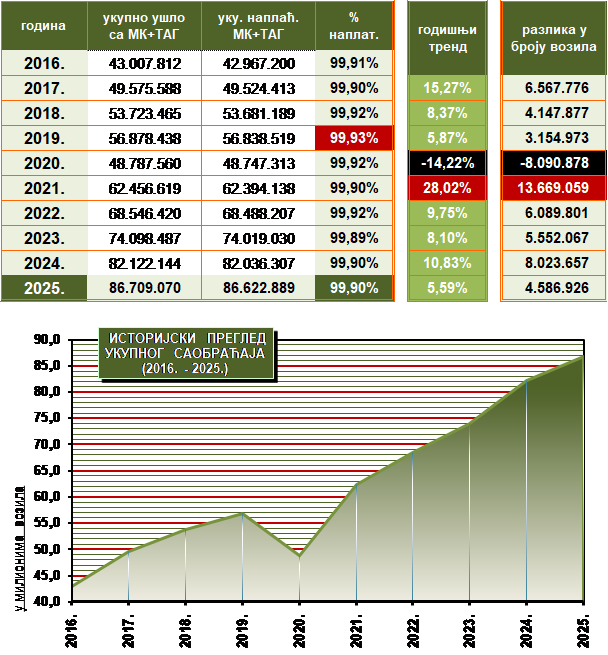
The increase in overall motorway traffic also confirms that we are on the right track in setting our priorities. While 43,007,812 vehicles passed through the toll collection system in 2016, this figure reached 86,709,070 vehicles in 2025.
The Sector is actively involved in the preparation of the National Transport Strategy of the Republic of Serbia for the period 2027–2034, financed by the World Bank through the Trade and Transport Facilitation Programme for the Western Balkans.
The Strategy covers all modes of transport and three cross-cutting themes: transport decarbonisation, with a focus on e-mobility; the introduction of new technologies and digitalisation; and climate resilience. Serbia’s transport system is currently undergoing a transition – from a predominantly infrastructure-based and sectorally organised system towards the gradual development of an integrated, interoperable and multimodal system aligned with European transport policies and the TEN-T framework.
The European transport development framework operates not only through regulations, standards and alignment with the TEN-T network, but also through financial instruments that guide the selection, preparation and implementation of priority investments. During the pre-accession period, in which the Republic of Serbia currently finds itself, instruments such as IPA III and the Economic and Investment Plan for the Western Balkans are available. The Western Balkans Investment Framework links reforms, investment maturity, climate and environmental requirements, and regional connectivity with access to grants, loans and technical assistance.
Contact telephone: 011/3040 742
Fax: 011/3040 692
E-mail: This email address is being protected from spambots. You need JavaScript enabled to view it.
* Materials for the Sector for Strategy, Designing and Development prepared by:
Chief Engineer for Strategic Planning
Ivana M. Kostić, MSc Civil Eng.